
Teamsters at Cargill prepare for second vote after locked-out workers narrowly reject contract
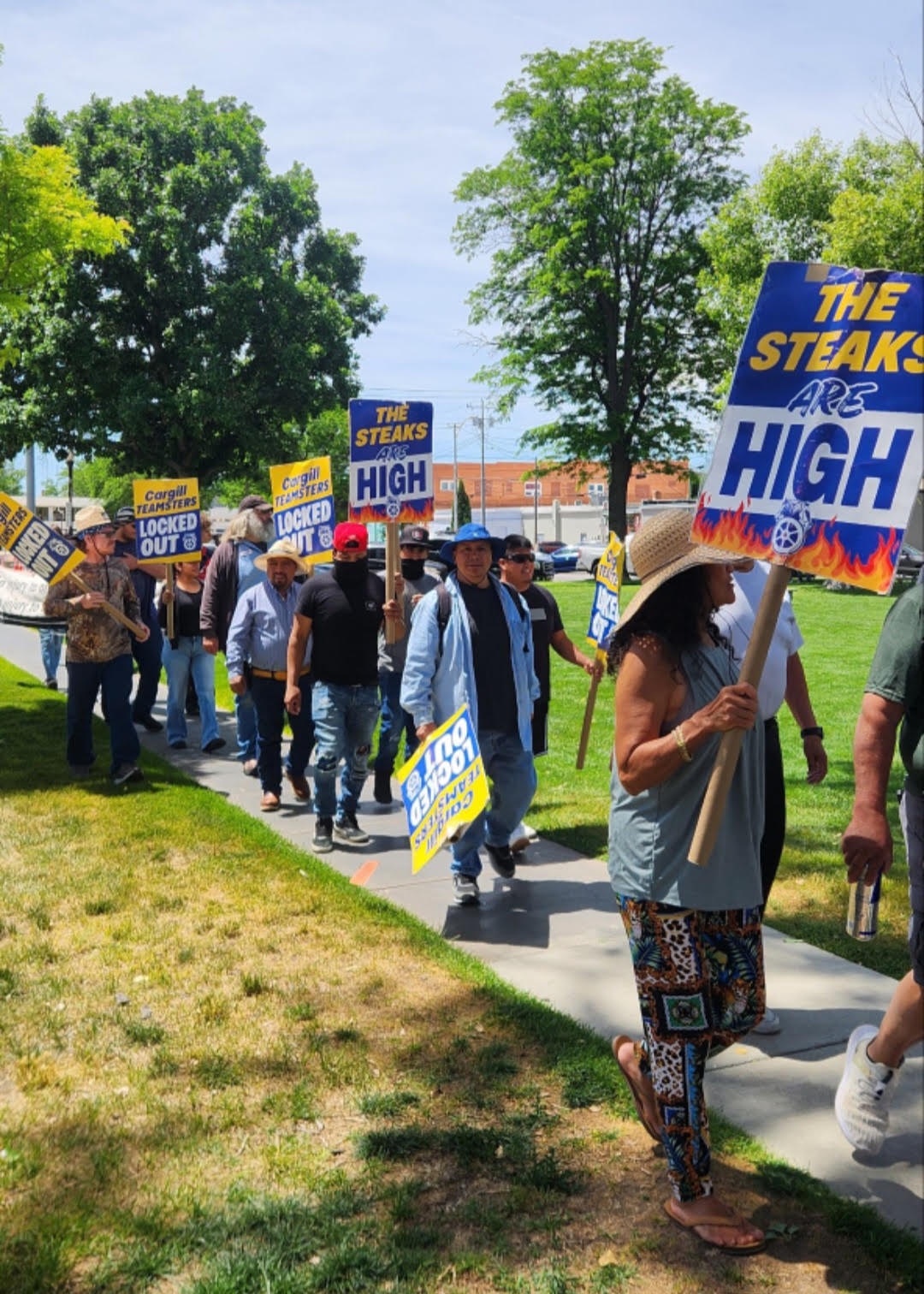
Fort Morgan, CO — On Monday, August 3, nearly 1500 Cargill workers in Fort Morgan voted on a proposed contract negotiated by Cargill Meat Solutions and Teamsters Local 455. The vote comes after the employer locked out the union workers for nearly three months. When the ballots were counted, the workers had voted to reject the proposed agreement by a margin of 25 votes, 749 to 724.
In anticipation of a strike, Cargill stopped processing beef on April 23 and later locked out the Teamsters Local 455 members on May 20. Before the lockout, the plant had already gone nearly a month without processing cattle, as Cargill directed cattle to other facilities. The Fort Morgan plant processed roughly 4000 cattle per day last year. Cargill reported $154 billion in revenue in 2025 and was ranked by Forbes as the largest privately-held company in the United States.
In contract negotiations, the workers had proposed $5 hourly wage increases over the course of a five-year contract. “If they truly respected us and cared about the work we do they wouldn't have a problem giving us a dollar a year raise. Without us they have nothing,” said Korin Turner, a Cargill meatpacker. The tentative agreement reached between Teamsters Local 455 on July 28 offered $2.15 total in wage increases, which was the same amount that Cargill had offered back in in May.
Guaranteed hours became a central point of opposition to the tentative agreement. Workers said the proposed agreement would increase the number of weeks in which they could be guaranteed only 32 hours of pay from ten weeks under the previous contract to 20 weeks. “For us to drive to work five days a week and only get 32 hours, that's barely enough to live. We have kids. We need to support our families,” said Sarah Webber, a Cargill fabrication worker. “Twenty weeks out of the year only 32 hours is a big slap in the face. Our previous contract only had ten weeks a year. They doubled it in this contract.” Some workers reported working even fewer hours.
“We weren't even getting the 32 hours, only 26 or 28 hours,” said Lucilia Fuentes, a Teamsters-represented trainer on the killing floor.
Safety was another concern raised by many Cargill workers during the lockout. Several picketing Cargill employees reported suffering serious injuries involving meat-processing equipment, and multiple workers at the picket had missing fingers or visible scars on their hands.
Don Wireman, a Cargill worker who sorts the meat after it's been packaged, said, “There's boxes stacked so high they fall over on people and they can't move until the person next to them is unburying them, digging them out.”
“We have three coworkers that are missing half their fingers,” said Makayla Wilson, a Teamsters-represented control room operator at Cargill.
During the lockout, the International Brotherhood of Teamsters (IBT) paid workers $1000 per week, with an additional $250 per week coming from Teamsters Local 455. The union payments were substantially higher than the weekly earnings many workers reported receiving before the lockout. “We're getting $1250 a week right now,” said Fuentes, when interviewed one month into the lockout. “Before we were making four to five hundred a week.”
On July 20, Teamsters Local 455 stopped its $250 weekly payments and encouraged workers to apply for unemployment. “I'm getting $1250,” said Wireman. He explained that $1000 was coming from the IBT and $250 from Teamsters Local 455. “But starting the 20th, so, next week, we're only getting $1000 because they're not paying the $250.”
On August 4, one day after workers rejected the proposed contract, the IBT announced that the $1000-per-week payments would be reduced to five times each member's monthly union dues. Based on monthly dues ranging from $58.75 to $72.50, that would reduce weekly payments to approximately $294 to $363.
After workers voted down the agreement negotiated between Cargill and Teamsters Local 455 on August 3, a group of workers started a petition demanding a re-vote.
“We had a large group of members that felt like there was some misunderstanding through the language barriers,” said Chris Suazo, a Teamsters business agent representing the 1700 locked-out Cargill workers, among whom 27 different languages are spoken. “They took it upon themselves to start a petition,” said Suazo.”
“Over a thousand signed the petition,” said Servando Payan, another Teamsters business agent.
Suazo said Teamsters officials are taking a different approach to the second vote. “[We're] being very clear what a no vote would entail and what a yes vote would entail. We're now doing the ballots in their languages – Haitian Creole, Arabic, Spanish, French, Somali, Tigrinya.”
Teamsters officials defended the proposed agreement, saying they believed they had secured the best possible contract. “I believe our group has done the beef industry a great service,” said Suazo. “We've done everything possible to support them and put the workers first.” Payan said, “We feel comfortable saying we walked away from the table without any additional money on the table.”
Teamsters’ officials have scheduled a second vote for August 17, where workers will once again decide whether to accept the proposed contract while the nearly three-month lockout continues.
Editor’s note: The agreement was approved on August 17.
#FortMorganCO #CO #Labor #Teamsters #Cargill #Strike #TeamstersLocal455