Fight Back! News

News and Views from the People's Struggle

marxismleninism

By J. Sykes

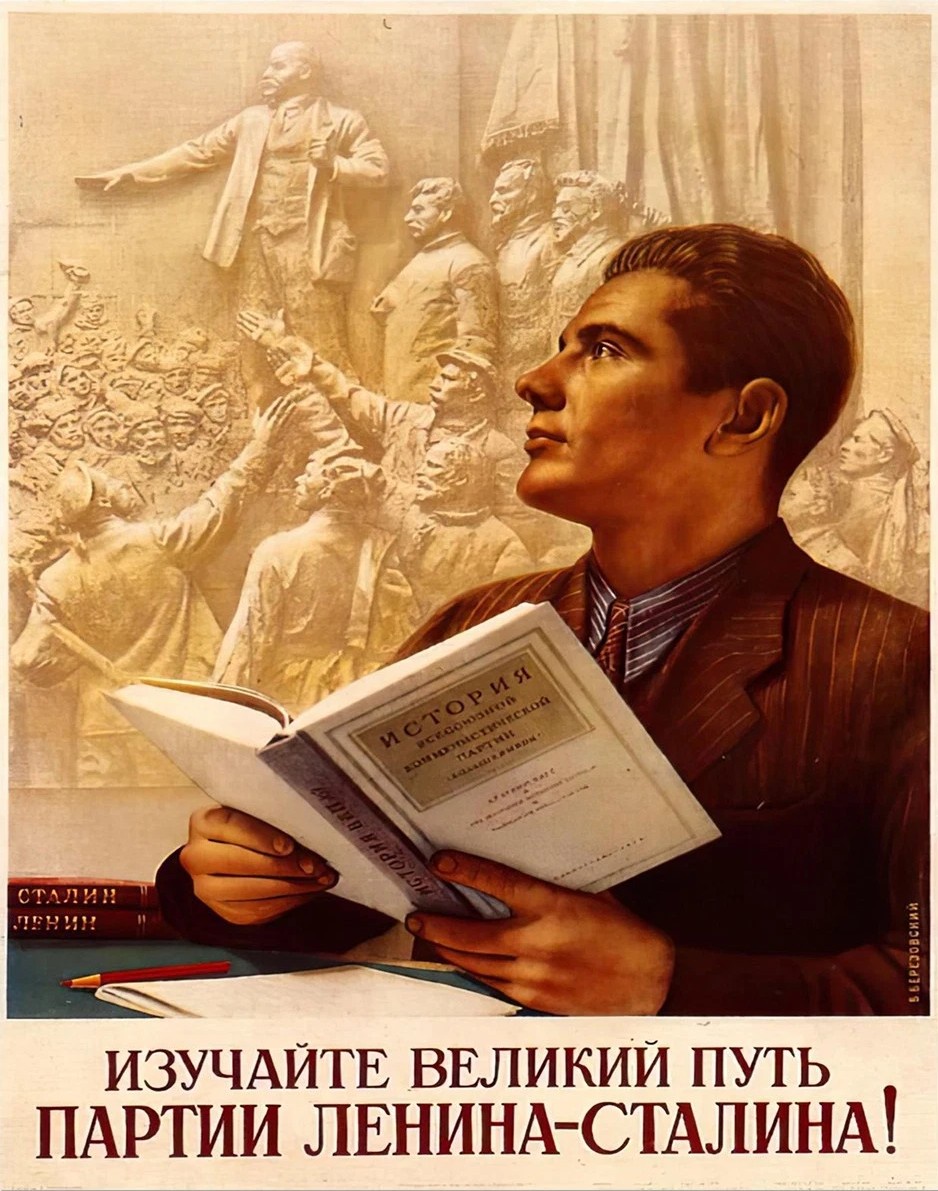
Soviet poster promoting the book History of the CPSU - Short Course.

In his extraordinary work, The Foundations of Leninism, J.V. Stalin, the principal leader of the Soviet Union after Lenin, explained, “Theory is the experience of the working-class movement in all countries taken in its general aspect.” In other words, theory is based on the summation of practical experience. General lessons are drawn from that experience, and then applied, tested and enriched through application in practice to our particular conditions. The 1938 work The History of the Communist Party of the Soviet Union (Bolsheviks) – Short Course stands out as an invaluable wellspring of theory because it provides a summation of the experiences of the Bolshevik Revolution from a Marxist-Leninist perspective. It is a summation that we can and must learn from to apply to the revolutionary tasks at hand here and now.

Read more...

By J. Sykes

The revolutionary struggle that brought about the first socialist state in the former Russian Empire in 1917 had its first major upheavals years earlier. The Russian Social Democratic Labor Party (RSDLP) had split into two factions, the Bolsheviks (meaning majority, led by V.I. Lenin) and Mensheviks (meaning minority, led by Julius Martov) in 1903. The RSDLP remained as one party formally, but the two factions, practically, had separate centers, presses, and programs. As The History of the Communist Party of the Soviet Union (Bolsheviks) – Short Course puts it, “on the eve of the first Russian revolution, when the Russo-Japanese war had already begun, the Bolsheviks and the Mensheviks acted as two separate political groups.”

The Russo-Japanese war broke out in 1904, and the Bolsheviks and Mensheviks each took a different stance toward the war. “The Mensheviks, including Trotsky, were sinking to a position of defending the ‘fatherland’ of the tsar, the landlords and the capitalists,” says the Short Course. “The Bolsheviks, headed by Lenin, on the other hand, held that the defeat of the tsarist government in this predatory war would be useful, as it would weaken tsardom and strengthen the revolution.”

By 1905 the struggle came to a head. The Short Course sums it up like this: 

“The workers' recourse to mass political strikes and demonstrations, the growth of the peasant movement, the armed clashes between the people and the police and troops, and, finally, the revolt in the Black Sea Fleet, all went to show that conditions were ripening for an armed uprising of the people. This stirred the liberal bourgeoisie into action. Fearing the revolution, and at the same time frightening the tsar with the spectre of revolution, it sought to come to terms with the tsar against the revolution; it demanded slight reforms ‘for the people’ so as to ‘pacify’ the people, to split the forces of the revolution and thus avert the ‘horrors of revolution.’ ‘Better part with some of our land than part with our heads,’ said the liberal landlords. The liberal bourgeoisie was preparing to share power with the tsar.’

In this time of great upheaval, the RSDLP lacked unity over tactics on how to move forward. The Bolsheviks called the Third Congress in order to assess the situation and formulate tactics that the whole party would be bound to carry out. But the Mensheviks boycotted the Third Congress and called their own “conference” in order to formulate their own tactical line apart from the Bolsheviks. 

The Third Party Congress correctly assessed that the liberal bourgeoisie didn’t want complete victory for the revolution but would instead seek compromise with the tsar on the basis of forming a constitutional monarchy. Therefore, it called for the proletariat to lead the bourgeois-democratic revolution, allied closely with the peasantry, since those were the class forces fundamentally interested in complete victory. The Menshevik conference, on the other hand, insisted that the democratic revolution be led by the liberal bourgeoisie, and that revolutionary socialists should make every effort to avoid frightening the liberal bourgeoisie and thereby undermining the revolution. The Bolsheviks advocated the revolutionary overthrow of tsarism, and the continuation of the revolution from its bourgeois-democratic stage to its socialist stage, while the Mensheviks instead advocated a policy of compromise and reform. 

Lenin’s arguments

Lenin’s book, Two Tactics of Social Democracy in the Democratic Revolution appeared two months after the Third Congress, in July 1905. It explained and developed the Bolshevik tactical line as it exposed and criticized the Menshevik tactical line. 

There are three main points in Lenin’s book that must be emphasized. 

First, Lenin argued that the proletariat must be the leader and guiding force of the bourgeois-democratic revolution. Thus, in Two Tactics Lenin writes, 

“Marxism teaches the proletarian not to keep aloof from the bourgeois revolution, not to be indifferent to it, not to allow the leadership of the revolution to be assumed by the bourgeoisie but, on the contrary, to take a most energetic part in it, to fight most resolutely for consistent proletarian democracy, for carrying the revolution to its conclusion. We cannot jump out of the bourgeois-democratic boundaries of the Russian revolution, but we can vastly extend these boundaries, and within these boundaries we can and must fight for the interests of the proletariat, for its immediate needs and for the conditions that will make it possible to prepare its forces for the future complete victory.”

For this reason, Lenin writes, “The outcome of the revolution depends on whether the working class will play the part of a subsidiary to the bourgeoisie, a subsidiary that is powerful in the force of its onslaught against the autocracy but impotent politically, or whether it will play the part of leader of the people’s revolution.” To do this, Lenin held that it was necessary for the proletariat to ally itself with the peasantry, on the one hand, and, on the other hand, to isolate the liberal bourgeoisie and force it out of leadership of the revolution. 

Second, Lenin argued that the means for overthrowing tsarism and achieving a democratic republic was through revolutionary armed struggle. 

In Two Tactics Lenin writes, “In order to be able to exercise this pressure from below, the proletariat must be armed—for in a revolutionary situation matters develop with exceptional rapidity to the stage of open civil war – and must be led by the Social-Democratic Party. The object of its armed pressure is that of ‘defending, consolidating and extending the gains of the revolution,’ i.e., those gains which from the standpoint of the interests of the proletariat must consist in the fulfilment of the whole of our minimum program.”

Against the Mensheviks, who advocated for reform during a revolutionary situation, Lenin wrote, “under the circumstances … amendments are moved by means of street demonstrations, interpolations are introduced by means of offensive action by armed citizens, opposition to the government is effected by forcibly overthrowing the government.” 

Third, Lenin argued that the revolution should have two stages, and that the revolution must not come to a halt with the victory of the bourgeois-democratic stage. Instead, it must strive immediately to pass into the socialist stage.

Therefore, Lenin writes in Two Tactics, “The proletariat must accomplish the socialist revolution, by allying to itself the mass of the semi-proletarian elements of the population in order to crush by force the resistance of the bourgeoisie and to paralyze the instability of the peasantry and the petty bourgeoisie.”

The Short Course points out, “This was a new theory which held that the Socialist revolution would be accomplished not by the proletariat in isolation as against the whole bourgeoisie, but by the proletariat as the leading class which would have as allies the semi-proletarian elements of the population, the ‘toiling and exploited millions.’” It goes on to explain, “According to this theory the hegemony of the proletariat in the bourgeois revolution, the proletariat being in alliance with the peasantry, would grow into the hegemony of the proletariat in the Socialist revolution, the proletariat now being in alliance with the other laboring and exploited masses, while the democratic dictatorship of the proletariat and the peasantry would prepare the ground for the Socialist dictatorship of the proletariat.”

The hegemony of the proletariat in the bourgeois-democratic revolution, the necessity of revolutionary armed struggle, and the importance of carrying the revolution forward from the democratic to the socialist stage: these are the most important lessons to draw from Lenin’s Two Tactics

Two Tactics today

After 1905, the democratic revolution in Russia entered a period of retreat, and wouldn’t be completed until February of 1917, after which the Bolsheviks did indeed push the revolution forward to the victorious October socialist revolution. 

Regarding Lenin’s book, Two Tactics, the Short Course says, “Its invaluable significance consists in that it enriched Marxism with a new theory of revolution and laid the foundation for the revolutionary tactics of the Bolshevik Party with the help of which in 1917 the proletariat of our country achieved the victory over capitalism.”

It is important that revolutionaries study this cornerstone of Marxist-Leninist theory today. Indeed, it explains in clear terms how revolutionaries should relate to the movements for democracy and the other class forces involved in those movements. It lays out the basic principles at the core of Leninist tactics. The lessons of Two Tactics apply to our own struggle in the U.S., where different class forces are united in struggle against monopoly capitalism. At the core of this united front is the strategic alliance of the multinational working class on the one hand and the movements of the oppressed nations and nationalities for liberation on the other hand. Lenin’s Two Tactics explains clearly the importance of the leadership of the proletariat and its need for allies. And while we must push forward and develop the struggle to defend and expand democracy in a revolutionary way, we must advance to the overthrow of the capitalist system and struggle for socialism.

#RevolutionaryTheory #Socialism #MarxismLeninism #MLTheory #RedTheory

By Freedom Road Socialist Organization

50 years ago, on April 30, the gates of the Presidential Palace in Saigon were broken by a tank—a tank driven by a fighter for a unified and independent Vietnam. The flag of the U.S.-backed puppet regime came down, and the flag of the National Liberation Front replaced it.

Saigon, the capital of French colonialism, and then American imperialism, was no more. Saigon became Ho Chi Minh City—named for the communist leader who stood at the forefront of Vietnam’s fight for national liberation.

Read more...

By J. Sykes

In 1951 the principal leader of the Soviet Union, Joseph Stalin, published Economic Problems of Socialism in the USSR. While it is a rather small book, its importance in the Marxist-Leninist understanding of socialism is quite large, and it deserves to be studied carefully. The book itself is a product of the discussions and debates in preparation of the excellent textbook, Political Economy, published by the Economics Institute of the Academy of Sciences of the U.S.S.R. Preparation of this textbook under Stalin’s guidance began as early as the late 1930s and was nearing completion in 1941 before it was delayed by the outbreak of World War II. As a result, it wasn’t finally published until 1954, shortly after Stalin’s death. 

Read more...

By J. Sykes

Naturally, we trace the origin of Marxism-Leninism to the theories of Karl Marx. The science of revolution bears his name, after all, together with Lenin’s. But of course we should understand that Marx wasn’t born a Marxist. This brings us to the question, which of Marx’s theories can we say are representative of Marxism? In other words, when did Marx become a Marxist, and why? By answering this, we not only proof ourselves against the dogmatist error or thinking Marxism is “whatever Marx wrote,” but we also come to a clearer understanding of what distinguishes Marxism as such.

Read more...

By J. Sykes

In 1942, Mao Zedong and the Communist Party of China launched a rectification movement in the Yan’an base area during the difficult years of the Second United Front. This was in the middle of the War of Resistance Against Japan. During this time, the civil war between the Communist Party of China and the reactionary Kuomintang was put on hold in order to unite and fight back against the invasion of Japanese fascism.

Read more...

By J. Sykes

Lenin’s important work, The Proletarian Revolution and the Renegade Kautsky, is a pamphlet written in 1918, responding to a pamphlet by the principal leader of the Second International, Karl Kautsky, entitled The Dictatorship of the Proletariat

Read more...

By J. Sykes

The purpose of Marxist analysis is so that we can know how to make revolution, so that we understand the terrain of struggle, formulate correct strategy and tactics, and identify our friends and enemies. We must understand the contradictions at work in society and unite all who can be united if we want to win. So, we need to be very careful and precise in that analysis.

Read more...

By J. Sykes

Lenin’s important book, “Left Wing” Communism, An Infantile Disorder, was written in 1920. According to the subtitle of the original manuscript, it was intended to be “a popular exposition on Marxist strategy and tactics.” After the victory of the Great October Socialist Revolution in 1917, the working class in the former Russian Empire had smashed its chains and set out on the road to socialism. Revolutionaries all over the world were eager to understand how the Bolsheviks had succeeded in defeating Tsarism and imperialism. Lenin, therefore, wrote this book to help guide the international communist movement and to sum up some of the critical lessons of the revolution in Russia.  

Read more...

By J. Sykes

Five Essays on Philosophy collects five important essays on dialectical materialism and Marxist epistemology, or the theory of knowledge, by Mao Zedong. It includes the articles “On Practice” and “On Contradiction” as well as “On the Correct Handling of Contradictions Among the People,” “Speech at the Chinese Communist Party's National Conference on Propaganda Work,” and “Where do Correct Ideas Come From?” 

Read more...

By J. Sykes

Portrait of Stalin in the civil war.

The Foundations of Leninism is a collection of lectures given by J.V. Stalin to Sverdlov University in 1924, shortly after the death of Lenin in January of that year. The nine lectures that make up the book cover topics of history, methodology, style of work, theory, and strategy and tactics, as well as exposition and analysis of particular issues, such as the party, the dictatorship of the proletariat, the national question, and the peasant question. On each of these topics, Stalin lays out the Leninist position succinctly and concretely. 

Read more...

By J. Sykes

When the first World War broke out in 1914, it threw the socialist movement into disarray. Within the Second International, socialist leaders from all over the world disagreed on how to analyze the causes of the war and the way forward. According to Vladimir I. Lenin: A Political Biography by the Marx-Engels-Lenin Institute, “On the very outbreak of the war he set to work to make a profound and detailed study of the world literature on the economics, methods of production, history, geography, politics, diplomacy, the working class movement, the colonial question, and other spheres of social life in the different countries in the epoch of imperialism.” These Notebooks on Imperialism, over 600 pages of copious research, make up Volume 39 of his Collected Works. The Institute notes, “The fruit of this vast work of research was Lenin’s famous book Imperialism, the Highest Stage of Capitalism. Completed in June 1916, this book is one of the greatest works in Marxist-Leninist literature.”

Read more...

By J. Sykes

In 1848 a great revolutionary upsurge spread through Europe. These revolutions swept through Italy, France, Germany, Austria, Hungary, Sweden, Switzerland, Poland, Ireland and other parts of Europe. By and large, these were democratic revolutions against feudalism, waged by the bourgeoisie, the petty bourgeoisie and the working class. In the midst of this wave of revolution, Karl Marx and Friedrich Engels joined the underground German Communist League. Marx and Engels were tasked with writing the program of the Communist League, The Manifesto of the Communist Party, a document that would explain the organization's analysis of the situation and its plan for how to move from that situation to revolution and socialism. 

Read more...

By J. Sykes

Vladimir Lenin was the great leader of the Bolshevik Revolution that overthrew tsarism and capitalism in Russia and built a new socialist society, for the first time in history. His book The State and Revolution is one of his greatest contributions to Marxist theory and is a cornerstone of Leninism.

Read more...

By J. Sykes

Karl Marx is best known in the realm of political economy for his great work, Capital. Marx is the original theorist, together with his associate Friedrich Engels, of scientific socialism. Marx wrote Capital in order to expose the inner workings of capitalism, so that workers could understand the system behind their exploitation, how this system arose historically, and the laws of motion inherent within it.

Read more...

By J. Sykes

Friedrich Engels.

Today we are launching a new series on Marxist-Leninist theory, focusing on important texts from the principal theorists of Marxism-Leninism: Karl Marx, Friedrich Engels, Vladimir Lenin, Joseph Stalin and Mao Zedong. In these short reviews, we will look briefly at the historical context of the text, we will break down the main argument and points, and we will talk about how the text remains relevant and applicable to revolutionaries today. We will begin with Socialism, Utopian and Scientific, by Friedrich Engels.

Read more...

By Freedom Road Socialist Organization

The following text was presented by Michela Martinazzi, a member of the Central Committee of the Freedom Road Socialist Organization at the International Assembly Against Imperialism in Solidarity with Palestine organized by Workers World Party.

Comrades and friends,

On behalf of the Freedom Road Socialist Organization, let’s start by thanking the organizers of this important event – Workers World Party – for bringing us together at a truly critical juncture in world history. By sharing views and analyses of the world as it actually is, we can learn from each other, and, from those insights, make plans to challenge the existing order of things.

We are certain this International Assembly against Imperialism in Solidarity with Palestine will be a great success. The old world is exploding, something new is coming into being.

The great revolution that is underway in Palestine is nothing short of amazing. In the face of genocide, the Palestinian people are waging a fight that has the potential to end the Zionist project and limit the influence of U.S. imperialism in the Middle East. Israel has always existed on stolen land and borrowed time. The clock is ticking.

Holding this Assembly on the 100th anniversary of the passing of the outstanding revolutionary V.I. Lenin was a good choice. This U.S. working class has a proud history that we sometimes lose sight of. For many years following Lenin’s death, revolutionaries held huge memorial meetings right here in New York City to mourn his passing and recommit to the revolutionary cause. For example, on January 21, 1937, more than 20,000 communists assembled in Madison Square Garden for that very purpose.

Lenin and imperialism

Lenin above all else was a revolutionary, who applied Marxism to the world around him and saw that competitive capitalism was giving way to monopoly capitalism. And this monopoly capitalism is what is referred to as imperialism. The two things are synonymous.

For today’s purposes, there isn’t time to recap Lenin’s great work, Imperialism, the Highest Stage of Capitalism. If there is anyone in hearing range who has not read it, get yourself a copy and do so. You won’t regret it. If you have done so, there is no harm in going over it again – odds are you will get something out of it.

Lenin drew a number of extremely important conclusions from the reality that capitalism had entered its imperialist stage, and I am going to focus on a few of them.

First, noting the world had been divided up amongst a handful of great powers, Lenin pointed out that wars to redivide the world were inevitable. He stressed that the only way to end imperialist wars was by ending imperialism and replacing it with socialism.

Lenin also appreciated the vital role that the majority of humanity in the colonies and semi-colonies would exercise, and that the contradiction between imperialism and oppressed peoples of the world would occupy a vital place in the era of monopoly capitalism.

In his important 1913 article Backward Europe and Advanced Asia, Lenin contrasts the broad progressive national democratic movement in China with the monopoly capitalist rulers of Europe. Of China, he said “Hundreds of millions of people are awakening to life, light and freedom”, and of Europe’s rulers Lenin stated, “Advanced Europe is commanded by a bourgeoisie which supports everything that is backward.”

Lenin knew what all socialists and communists needed to realize as well, and, quite honestly, it is pretty likely everyone here today gets this – any movement of the oppressed that weakens imperialism is a good thing. It deserves our support and solidarity. It is like the question posed in the old labor song, “Which Side Are You On?”

Every setback for Wall Street is an advance for Main Street. Working and oppressed people in the U.S. have a common cause with all who are oppressed by imperialism. Every ship turned around by Yemen helps those of us who are fighting to end exploitation here in the U.S. – we have the same enemy. Do we want strong enemies? No, we want weak and defeated ones. By the same token, every blow that we are able to inflict on the class enemy aids those suffering under imperialism’s yoke.

Palestine and the decline of U.S. imperialism

The decline of U.S. imperialism is accelerating. The people of Palestine are showing the way. All of us need to learn from their will to sacrifice and determination to win.

Lenin stressed that imperialism was capitalism that is moribund; it is dying. And we can see the symptoms all around them, including their political representatives. I invite you to join us at the Republican National Convention, July 15 in Milwaukee, and at the Democratic National Convention, August 19, in Chicago to confront them.

Marx talked about the vampire-like nature of capitalism. Let’s build unity. The many against the few. The people of the world can and will unite. Together we will put a stake in the heart of imperialism.

#FRSO #RevolutionaryTheory #International #Palestine #Imperialism #Lenin #MarxismLeninism

By J. Sykes

Since the writing of The Communist Manifesto and the founding of the First International, proletarian internationalism has been a cornerstone of scientific socialism, and is a pillar of Marxism-Leninism. Today, in the era of imperialism, putting genuine proletarian internationalism into practice demands that we be consistent anti-imperialists.

Read more...

By J. Sykes

December 26, 2023 marks the 130th anniversary of the birth of the great leader and teacher of the Chinese revolution, Mao Zedong. This is an excellent occasion to review Mao’s contributions as one of the principal theorists of the science of revolution, Marxism-Leninism.

Read more...

By Mick Kelly, FRSO Political Secretary

The following text was present by Mick Kelly, the political secretary of Freedom Road Socialist Organization at a webinar organized by the People’s Resource for International Solidarity and Mass Mobilization (PRISM) and the International League of People’s Struggle (ILPS) to mark the 175th anniversary of “The Communist Manifesto.”

Comrades and friends,

Let me begin by thanking the organizers of this important event, the People’s Resource for International Solidarity and Mass Mobilization (PRISM) and the International League of People’s Struggle (ILPS) for today’s opportunity to learn from each other and share our respective views, as we mark the birth of The Communist Manifesto.

Read more...