
Interview with Chrisley Carpio on international delegation to South Korea: U.S. out of Korea now!
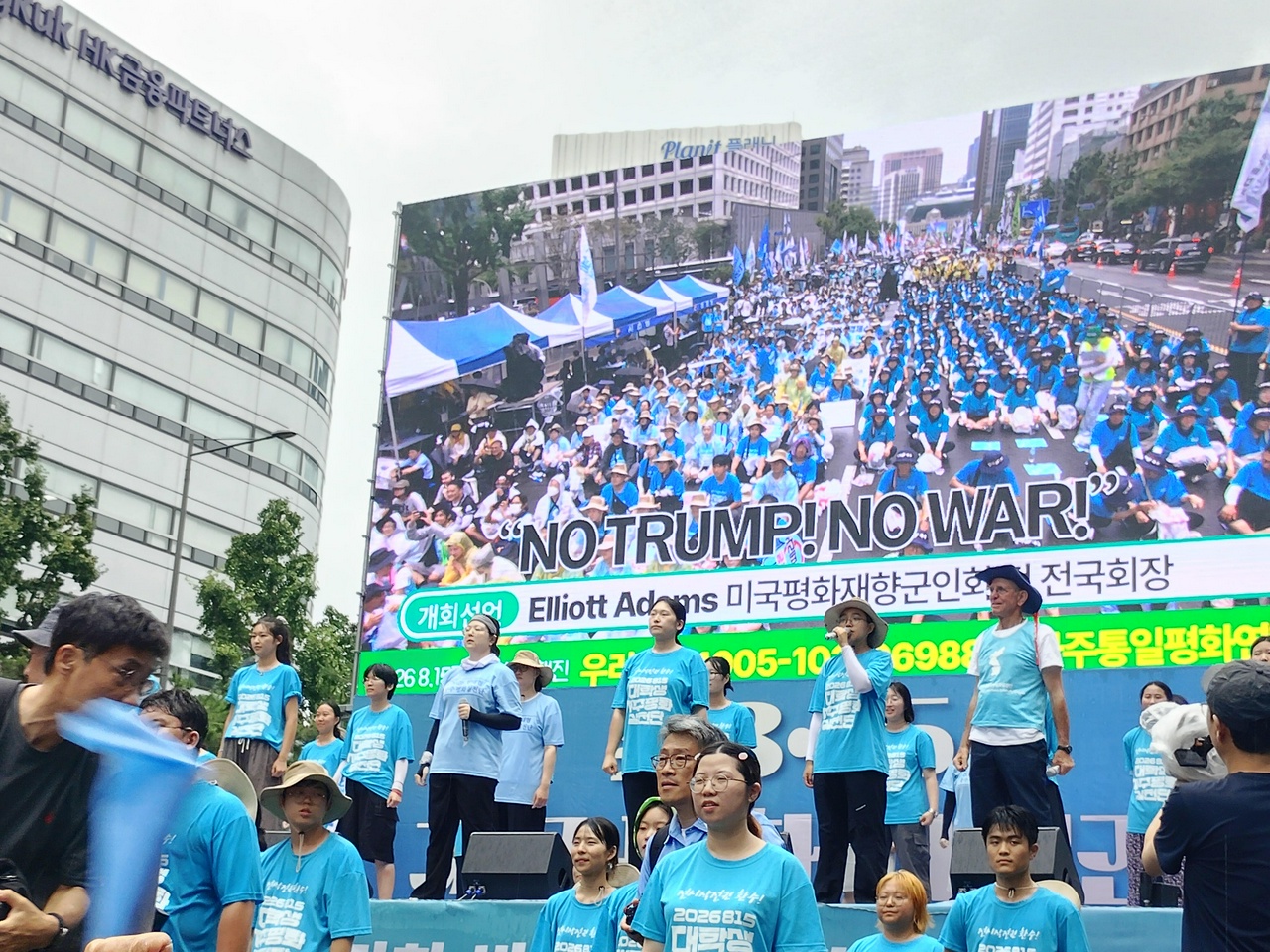
From August 9 through August 17, Chrisley Carpio of the Central Committee of the Freedom Road Socialist Organization took part in the Jaju Solidarity Brigade, the first international delegation to attend the annual August 15 Korean Liberation Day March, in what is known as the Republic of Korea. The Jaju Solidarity Brigade visited U.S. bases and sites of historic importance to the progressive movement in Korea and learned about various fronts of struggle for Korean peace, sovereignty and reunification.
Fight Back!: Can you briefly summarize the political situation on the Korean Peninsula? And its relationship to the United States?
Chrisley Carpio: The people of the Korean Peninsula were once a united people. Today, its people are divided by U.S. imperialism at the 38th parallel. The North, known as the Democratic Peoples’ Republic of Korea, is a liberated, socialist state that is in charge of its own affairs, including its government, military, economy and society. In the DPRK, every person is guaranteed a job, a place to live, and groceries such as rice and soy sauce, no matter the state of the economy.
South Korea, known as the Republic of Korea, is occupied by the United States. It is plagued by more than 62 U.S. bases. Instead of leaving in 1945 at the end of the Japanese occupation of Korea, U.S. military advisors stayed and took over bases and facilities previously used by the Japanese occupiers. Per the U.S.-South Korea Status of Forces (SOFA) Agreement, the U.S. government has operational control of the military of the ROK, which cannot act without its approval; it can take whatever land it wants, and the ROK must comply; and members of the U.S. military cannot be easily tried or held accountable to Korean laws no matter what crimes they commit.
The U.S. occupation has wrought murders of children, persecution of political prisoners, sexual violence against women, displacement from homes and farms, and many other atrocities besides. Recently, U.S. wartime preparations, such as the annual Ulchi Freedom Shield war games, have increased U.S. military activity in South Korea in an effort to keep it, in the words of U.S. Forces Korea Commander General Xavier Brunson, a “fixed aircraft carrier floating in the water” and “a dagger pointed at China.”
Fight Back!: What sites did you visit on the delegation? What did you take away from these stops?
Carpio: We visited two major gravesites in Daejeon: the National Cemetery where pro-Japanese collaborators are buried with tall, engraved gravestones not far from pro-independence fighters, and Sannae Golryeonggol, the site of the unmarked graves of the 300 anti-occupation political prisoners who were taken out of Daejeon Prison and shot, under the supervision of the U.S. military. We traveled to Gunsan Air Force Base and saw the breathtaking Sura Tidal Flats, the mud flats essential for the survival of 63 legally protected species, which the ROK government wants to demolish to make way for an expansion of Gunsan Air Base. Nearby is the Haje Village, where the people have rallied around a 600-year-old hackberry tree and hold monthly cultural festivals in its honor in an effort to take back ownership of land that was stolen.
Some distance from Paju City, we visited the Peace Park built after U.S. military tanks ran over Korean grade school girls, killing them, in 1988 and 2002. The 2002 killings of Shim Mi-seon and Shin Hyo-sun and the absence of any charges against the U.S. military killers led to mass candlelight vigils that demanded changes to the SOFA Agreement.
We protested the presence of the U.S. military at the Rodriguez Firing Range in Pocheon, which is the size of 1800 soccer fields, and did the same at Camp Humphreys in Pyeongtaek, the largest overseas U.S. base in the world. We saw the Daechu-Ri Hwangsaeul Memorial Hall, filled with photos of the farmers’ militant battle against the government to defend the rich agricultural lands which for generations had been theirs, before they were forcibly displaced.
We visited the STD Management Center near Camp Casey in Dongducheon, where Korean women were forced into prostitution in the nearby camp town, confined whenever a U.S. soldier was thought to have an STD, and shot with so much penicillin that they could not walk, only crawl. We saw the house where the Korean camptown woman Yun Geum-I was brutally murdered by U.S. Private Kenneth Lee Markle, who was only tried and jailed after massive protests by women’s organizations, student organizations, and many more. He was the first American ever to be successfully tried and imprisoned for crimes committed against a Korean in spite of the SOFA Agreement. It was this incident which marked the beginning of the decline of the use of Korean women to fill the camp town near Camp Casey, which is now filled with trafficked Filipino women.
For every death was a memorial hard-won by protest and struggle. For every addition to a U.S. base was an effort to stop its expansion. For every human rights violation was a fierce struggle for justice. This delegation showed me that the fight for peace, reunification, and national liberation from U.S. occupation is alive and well in Korea.
Fight Back!: What are the demands of the peace movement in Korea? What does this movement look like?
Carpio: The demands of the peace movement in Korea cut a wide scope: the departure of all U.S. government and military personnel from Korea; the closure of U.S. bases across the peninsula; ending the Ulchi Freedom Shield joint military exercises; ending preparations for war in the Indo-Pacific; the return of all land taken by the U.S. government; an end to the SOFA Agreement and the US-ROK alliance, and more.
At their core, the demands are for peace, sovereignty and the reunification of the Korean people. At the protests we saw this week were multiple trade union federations, student organizations, women’s organizations, peasants’ organizations, civil liberties groups, and more. To paint a picture for you, in Seoul, the Korean Liberation Day protest on August 15 mobilized 10,000 people, and to conclude the rally, all in attendance worked together to rip a giant American flag to shreds.
Fight Back!: What are the challenges that the movement in Korea faces today?
Carpio: In the ROK, there are brutal restrictions on freedom of speech going back to the earliest years of U.S. occupation, and these laws still operate. The National Security Act of 1948 criminalizes any positive discussion of North Korea, anti-state activity, and any discussion of communism in general. Even now, activists can face a decade or more in prison just for the publication of a book sympathetic to the North. Apart from repression, there also exists a growing far-right movement, which faces little to no hostility from the U.S.-backed ROK government. At the August 15 protest in Seoul, we encountered some of these right-wingers. We outnumbered them vastly.
Fight Back!: What stake do the peoples of the United States have in an end to the occupation in Korea? What can anti-imperialists in the United States do towards this end today?
Carpio: In the U.S., the people face economic hardships and social problems too—but where does our taxpayer money go? Instead of food stamps and unemployment benefits, our money goes to the destruction of precious environmental habitats in Korea, the leveling of schools, houses and farms, the manufacture of F-16s and stray bullets that fly out of U.S. bases to hit civilians, tanks that kill children, facilities that violate women.
Like the Korean people, we don’t have a say in these decisions. They are made for us by the rich war hawks who sit on Wall Street. The same yoke that holds us down—U.S. imperialism—has been holding down the people of South Korea for at least 73 years. At the end of the day, the peoples of the U.S. and of Korea have the same enemy, and we in the U.S. are in a good position to mobilize against war on China and war preparations in Asia, not only in Korea but also countries like the Philippines. We should take the so-called dagger that is Korea out of the hands of the U.S. imperialists and turn it around. We should march against imperialist wars. And we should stand stalwart and say: U.S. out of Korea! Long live international solidarity!