
Panel highlights decades of protests against Honeywell weapons facility in Minneapolis
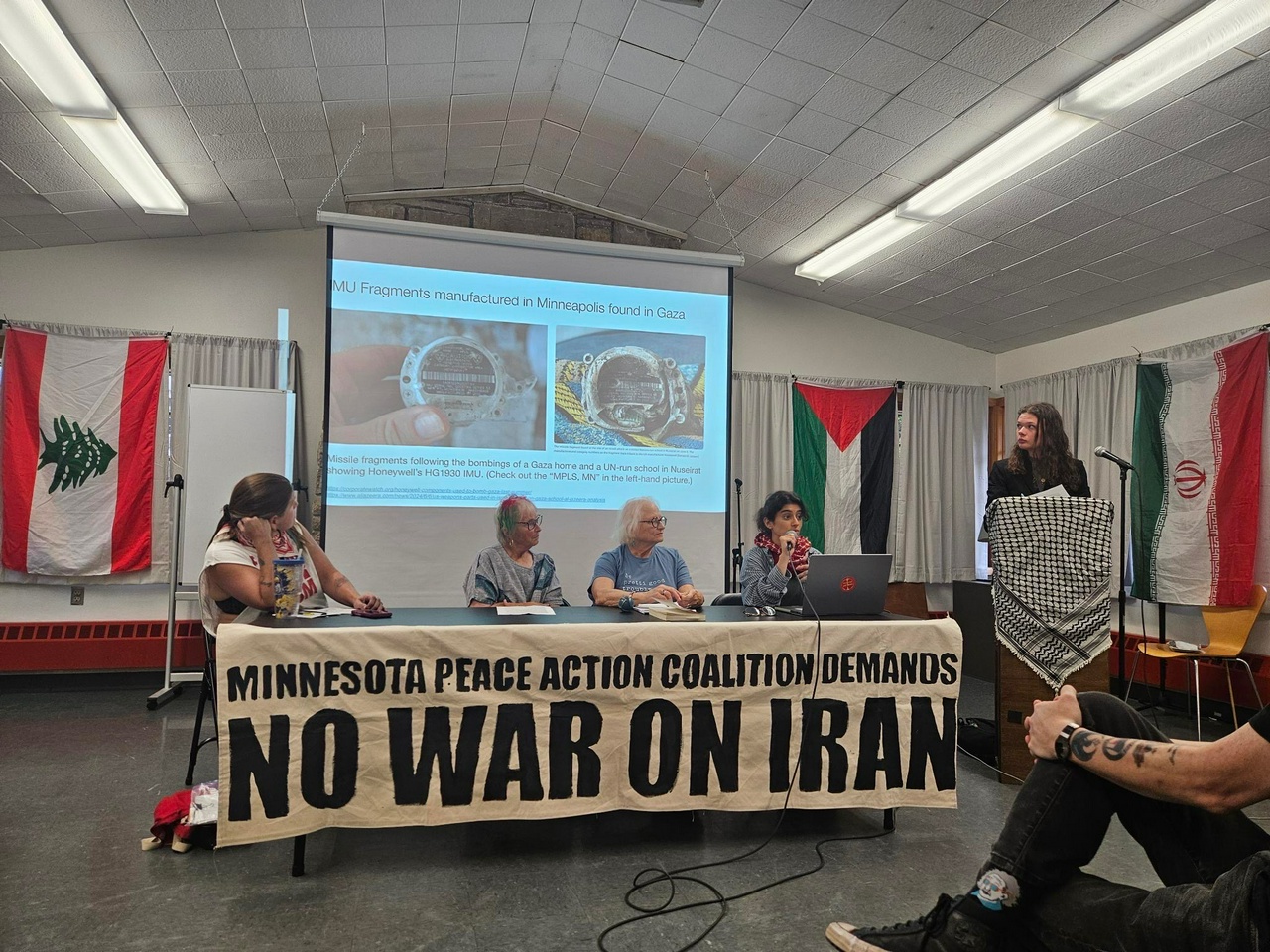
Minneapolis, MN – On Thursday, August 13, the Minnesota Peace Action Coalition (MPAC) hosted a panel titled “To Hell With Honeywell” at the Lucy Parsons Center. The panel shared the history of Honeywell’s production of weapons parts in Minneapolis, and local resistance efforts to its complicity in U.S. war crimes.
Honeywell is a prominent U.S. weapons manufacturer with a major facility operating right in the backyard of the Northeast neighborhood. Honeywell’s own website shows that in 2025 roughly 40% of its profits came from “Defense and Space,” with half of those profits coming from sales to the U.S. government.
The panelists condemned the new $500 million contract that Honeywell currently has with the Department of Defense. Under a separate defense contract, the Minneapolis Honeywell location was given over $30.8 million to accelerate production of technology in support of Israel’s genocide in Palestine, specifically, production of 1890 Advanced Anti-Radiation Guided Missile Extended Range (AARGMER) inertial measurement units (IMUs). These parts, used in missiles and military drones, are integral to the navigation of these weapons towards their targets.
The panel also featured organizers from the historic “Honeywell Project” in Minnesota spanning back to the 1960s. This decades-long campaign pressured the Minneapolis Honeywell location to stop the local production of cluster bombs used to commit war crimes in Southeast Asia and Lebanon.
During the presentation, images of IMUs found in Palestine after bombings showed production labels, “Honeywell, Inc. Mpls, MN.” Both Lockheed Martin and Boeing use these specific IMUs from Honeywell in a number of their fighter jets, missiles and bombs. Furthermore, the General Atomics company uses them in its infamous MQ-9 Reaper Drones. These weapons have been used by the U.S. and Israel to target people in countries across the globe, including Palestine, Lebanon, Iran, Venezuela, Somalia and Yemen.
In the case of this new Department of Defense contract, the Honeywell location in Minneapolis is unique, as the department states that these specific IMUs can only be produced at the Minneapolis Honeywell location without there being a significant delay in production.
Protesting Honeywell over the decades
Twin Cities residents are no strangers to disrupting production at Honeywell and telling war profiteers that they are not welcome. Longtime local organizers Sarah Martin, of Women Against Military Madness and the Honeywell Project in the 1980s, and Cindy Doll, also of the Honeywell Project and a Minnesota Nurses Association member, shared lessons. They explained how organizing led to the massive actions and extensive engagement that created roadblocks to Honeywell’s production and damaged its reputation over the years.
The panelists talked about the founders of the Honeywell Project, including anti-war and civil rights activist Marv Davidov, and 25 others who started meeting in 1968, when Honeywell’s corporate headquarters was located in Minneapolis. They shared the devastating impact of the 90 million cluster bombs, many made by Honeywell, that were dropped over Southeast Asia during the U.S. war on Vietnam. Unexploded ordinance is still killing civilians, many of them children, and farm animals decades later in places like Vietnam, Laos and Cambodia.
The Honeywell Project led leafleting campaigns, bannering actions outside of the homes of Honeywell executives, meetings with company leaders, vigils, civil disobedience actions, and demonstrations outside Honeywell headquarters and shareholder meetings.
Some of these actions included thousands of demonstrators. Martin said, “At an October protest in 1983, 575 people were arrested!”
Martin continued, “The people formed a chain around the headquarters,” adding, “These protests closed the headquarters down several times.” Panelists estimated there were 2200 arrests between 1980 and 1987.
Demonstrations continued against landmines, as the “Alliant Action” campaign in the 1990s, when Honeywell formed a new company, Alliant Techsystems, to include its defense division.
Describing years of direct action protests at the Honeywell headquarters in Minneapolis in the 1980s, Cindy Doll shared, “Being part of the Honeywell Project for me meant a great deal of learning about weapons, about the history of war, about protest movements, about government involvement in war at home and abroad” and “I learned how to talk to my city council representative, my employer, my family.”
Reflecting on the power of workers and organized labor, other panelists highlighted the role that activists and organized labor have in resisting Honeywell’s production of weapons parts.
Amber Mathwig with About Face: Veterans Against the War shared, “These IMUs are manufactured by unionized labor – Teamsters, specifically, here in Minneapolis. And I think that’s a really important aspect of challenging the military-industrial complex because so much of our organized labor is within the military industrial complex.” She explained, “There are challenges there in pointing out to people, ‘Hey, your lifestyle, your good union benefits, come at this huge expense to the cost of life around the globe.’ And that is one thing that About Face has been uniquely positioned to talk about.”
With such a strong local history of opposing U.S. militarism and Honeywell’s production of weapons in Minneapolis, advocates said that rich history can teach future generations.
Lina Jebara of the U.S. Palestinian Community Network and the Minnesota Anti-War Committee said, “We know disruption to Honeywell’s IMU production would be disastrous,” pointing out that, “With increased shortages, we really are particularly positioned in Minneapolis to affect the ability to which the U.S. and Israel are able to actually create these munitions and carry out these crimes against humanity.”