
Minneapolis panel explains U.S. imperialism is an environmental issue
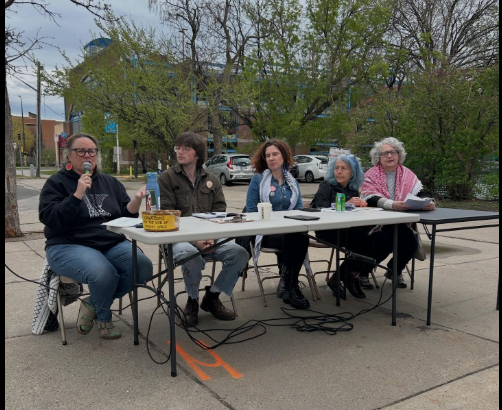
Minneapolis, MN – On April 25 Women Against Military Madness (WAMM) and the Climate Justice Committee (CJC) hosted a panel on the environmental consequences of U.S. imperialism.
The panel, held on the plaza right outside of May Day Books, took place a week after the People’s Earth Day March, and was an effort to deepen community understanding on the role of U.S. militarism in exacerbating climate change. April 25 was also Independent Bookstore Day so, in addition to the 30 people who attended, there was a steady stream of people who stopped by on their way in and out of the bookstore.
Liz McLister, representing WAMM’s Families Against Military Madness committee, opened the panel, “The United States boasts the largest military in human history, which is also the world’s largest polluter, gobbling up more petroleum than any institution on earth and emitting more greenhouse gases than some countries.”
McLister continued, “According to Brown University's Costs of War, the U.S. military drives the climate crisis in at least four ways. First by burning enormous amounts of fossil fuels. Second, through emissions-intensive military operations and installations. Third, through the destruction of soil, wetlands, forests and other natural areas that would otherwise absorb carbon. And fourth, by decimating civilian infrastructure and thereby leading to carbon-heavy reconstruction.”
Trish Knous, a member of WAMM’s Palestine Solidarity Committee and the CJC, spoke next about how U.S. imperialism has destroyed the environment in Palestine. “Today it [Gaza] is an area of flat, hard packed land and crushed cement. It is one of many villages, towns, and cities that no longer can support people's lives. When buildings are destroyed, wiring, insulation and asbestos release toxins into the air, land and water. Some of the bombs used penetrate the ground before exploding and release heavy metals such as uranium, lead and arsenic. Some of these metals decay slowly and will affect the composition of the soil and water for decades.”
The panel was closed out by Rebecca Scott from the CJC, who spoke about the environmental devastation from the current U.S.-Israeli war on Iran, “There were 14 million tons of carbon dioxide released in just the first 14 days alone.” She addressed “black rain,” the 14,000 buildings that have been demolished, and the impact of the U.S. bombing Iran’s oil infrastructure.
Panelists encouraged the attendees to protest against U.S. wars and to get involved.