
Red Reviews: “Two Tactics of Social Democracy in the Democratic Revolution”
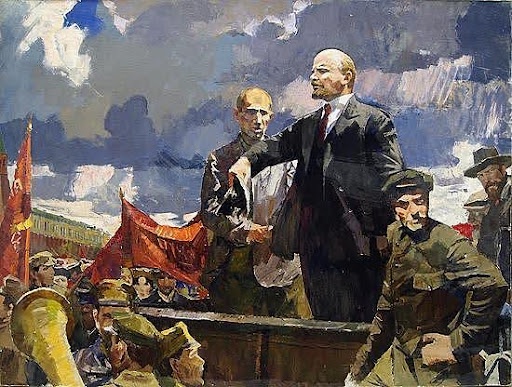
The revolutionary struggle that brought about the first socialist state in the former Russian Empire in 1917 had its first major upheavals years earlier. The Russian Social Democratic Labor Party (RSDLP) had split into two factions, the Bolsheviks (meaning majority, led by V.I. Lenin) and Mensheviks (meaning minority, led by Julius Martov) in 1903. The RSDLP remained as one party formally, but the two factions, practically, had separate centers, presses, and programs. As The History of the Communist Party of the Soviet Union (Bolsheviks) – Short Course puts it, “on the eve of the first Russian revolution, when the Russo-Japanese war had already begun, the Bolsheviks and the Mensheviks acted as two separate political groups.”
The Russo-Japanese war broke out in 1904, and the Bolsheviks and Mensheviks each took a different stance toward the war. “The Mensheviks, including Trotsky, were sinking to a position of defending the ‘fatherland’ of the tsar, the landlords and the capitalists,” says the Short Course. “The Bolsheviks, headed by Lenin, on the other hand, held that the defeat of the tsarist government in this predatory war would be useful, as it would weaken tsardom and strengthen the revolution.”
By 1905 the struggle came to a head. The Short Course sums it up like this:
“The workers' recourse to mass political strikes and demonstrations, the growth of the peasant movement, the armed clashes between the people and the police and troops, and, finally, the revolt in the Black Sea Fleet, all went to show that conditions were ripening for an armed uprising of the people. This stirred the liberal bourgeoisie into action. Fearing the revolution, and at the same time frightening the tsar with the spectre of revolution, it sought to come to terms with the tsar against the revolution; it demanded slight reforms ‘for the people’ so as to ‘pacify’ the people, to split the forces of the revolution and thus avert the ‘horrors of revolution.’ ‘Better part with some of our land than part with our heads,’ said the liberal landlords. The liberal bourgeoisie was preparing to share power with the tsar.’
In this time of great upheaval, the RSDLP lacked unity over tactics on how to move forward. The Bolsheviks called the Third Congress in order to assess the situation and formulate tactics that the whole party would be bound to carry out. But the Mensheviks boycotted the Third Congress and called their own “conference” in order to formulate their own tactical line apart from the Bolsheviks.
The Third Party Congress correctly assessed that the liberal bourgeoisie didn’t want complete victory for the revolution but would instead seek compromise with the tsar on the basis of forming a constitutional monarchy. Therefore, it called for the proletariat to lead the bourgeois-democratic revolution, allied closely with the peasantry, since those were the class forces fundamentally interested in complete victory. The Menshevik conference, on the other hand, insisted that the democratic revolution be led by the liberal bourgeoisie, and that revolutionary socialists should make every effort to avoid frightening the liberal bourgeoisie and thereby undermining the revolution. The Bolsheviks advocated the revolutionary overthrow of tsarism, and the continuation of the revolution from its bourgeois-democratic stage to its socialist stage, while the Mensheviks instead advocated a policy of compromise and reform.
Lenin’s arguments
Lenin’s book, Two Tactics of Social Democracy in the Democratic Revolution appeared two months after the Third Congress, in July 1905. It explained and developed the Bolshevik tactical line as it exposed and criticized the Menshevik tactical line.
There are three main points in Lenin’s book that must be emphasized.
First, Lenin argued that the proletariat must be the leader and guiding force of the bourgeois-democratic revolution. Thus, in Two Tactics Lenin writes,
“Marxism teaches the proletarian not to keep aloof from the bourgeois revolution, not to be indifferent to it, not to allow the leadership of the revolution to be assumed by the bourgeoisie but, on the contrary, to take a most energetic part in it, to fight most resolutely for consistent proletarian democracy, for carrying the revolution to its conclusion. We cannot jump out of the bourgeois-democratic boundaries of the Russian revolution, but we can vastly extend these boundaries, and within these boundaries we can and must fight for the interests of the proletariat, for its immediate needs and for the conditions that will make it possible to prepare its forces for the future complete victory.”
For this reason, Lenin writes, “The outcome of the revolution depends on whether the working class will play the part of a subsidiary to the bourgeoisie, a subsidiary that is powerful in the force of its onslaught against the autocracy but impotent politically, or whether it will play the part of leader of the people’s revolution.” To do this, Lenin held that it was necessary for the proletariat to ally itself with the peasantry, on the one hand, and, on the other hand, to isolate the liberal bourgeoisie and force it out of leadership of the revolution.
Second, Lenin argued that the means for overthrowing tsarism and achieving a democratic republic was through revolutionary armed struggle.
In Two Tactics Lenin writes, “In order to be able to exercise this pressure from below, the proletariat must be armed—for in a revolutionary situation matters develop with exceptional rapidity to the stage of open civil war – and must be led by the Social-Democratic Party. The object of its armed pressure is that of ‘defending, consolidating and extending the gains of the revolution,’ i.e., those gains which from the standpoint of the interests of the proletariat must consist in the fulfilment of the whole of our minimum program.”
Against the Mensheviks, who advocated for reform during a revolutionary situation, Lenin wrote, “under the circumstances … amendments are moved by means of street demonstrations, interpolations are introduced by means of offensive action by armed citizens, opposition to the government is effected by forcibly overthrowing the government.”
Third, Lenin argued that the revolution should have two stages, and that the revolution must not come to a halt with the victory of the bourgeois-democratic stage. Instead, it must strive immediately to pass into the socialist stage.
Therefore, Lenin writes in Two Tactics, “The proletariat must accomplish the socialist revolution, by allying to itself the mass of the semi-proletarian elements of the population in order to crush by force the resistance of the bourgeoisie and to paralyze the instability of the peasantry and the petty bourgeoisie.”
The Short Course points out, “This was a new theory which held that the Socialist revolution would be accomplished not by the proletariat in isolation as against the whole bourgeoisie, but by the proletariat as the leading class which would have as allies the semi-proletarian elements of the population, the ‘toiling and exploited millions.’” It goes on to explain, “According to this theory the hegemony of the proletariat in the bourgeois revolution, the proletariat being in alliance with the peasantry, would grow into the hegemony of the proletariat in the Socialist revolution, the proletariat now being in alliance with the other laboring and exploited masses, while the democratic dictatorship of the proletariat and the peasantry would prepare the ground for the Socialist dictatorship of the proletariat.”
The hegemony of the proletariat in the bourgeois-democratic revolution, the necessity of revolutionary armed struggle, and the importance of carrying the revolution forward from the democratic to the socialist stage: these are the most important lessons to draw from Lenin’s Two Tactics.
Two Tactics today
After 1905, the democratic revolution in Russia entered a period of retreat, and wouldn’t be completed until February of 1917, after which the Bolsheviks did indeed push the revolution forward to the victorious October socialist revolution.
Regarding Lenin’s book, Two Tactics, the Short Course says, “Its invaluable significance consists in that it enriched Marxism with a new theory of revolution and laid the foundation for the revolutionary tactics of the Bolshevik Party with the help of which in 1917 the proletariat of our country achieved the victory over capitalism.”
It is important that revolutionaries study this cornerstone of Marxist-Leninist theory today. Indeed, it explains in clear terms how revolutionaries should relate to the movements for democracy and the other class forces involved in those movements. It lays out the basic principles at the core of Leninist tactics. The lessons of Two Tactics apply to our own struggle in the U.S., where different class forces are united in struggle against monopoly capitalism. At the core of this united front is the strategic alliance of the multinational working class on the one hand and the movements of the oppressed nations and nationalities for liberation on the other hand. Lenin’s Two Tactics explains clearly the importance of the leadership of the proletariat and its need for allies. And while we must push forward and develop the struggle to defend and expand democracy in a revolutionary way, we must advance to the overthrow of the capitalist system and struggle for socialism.
#RevolutionaryTheory #Socialism #MarxismLeninism #MLTheory #RedTheory
 Currently, there is a wide ranging debate, originating among the ruling-class parties, about gun control. This is nothing new, but since the more recent epidemic of school shootings and other terrorist acts, such as the recent white chauvinist mass shooting in August 2023 at the Dollar General in Jacksonville, Florida, the issue of what to do about gun violence has become an ever-present issue. It is not an issue that people interested in revolution and socialism can avoid weighing in on. Indeed, it is only through revolution and socialism that it can truly be solved.


