
On the issue of fascism and the United States
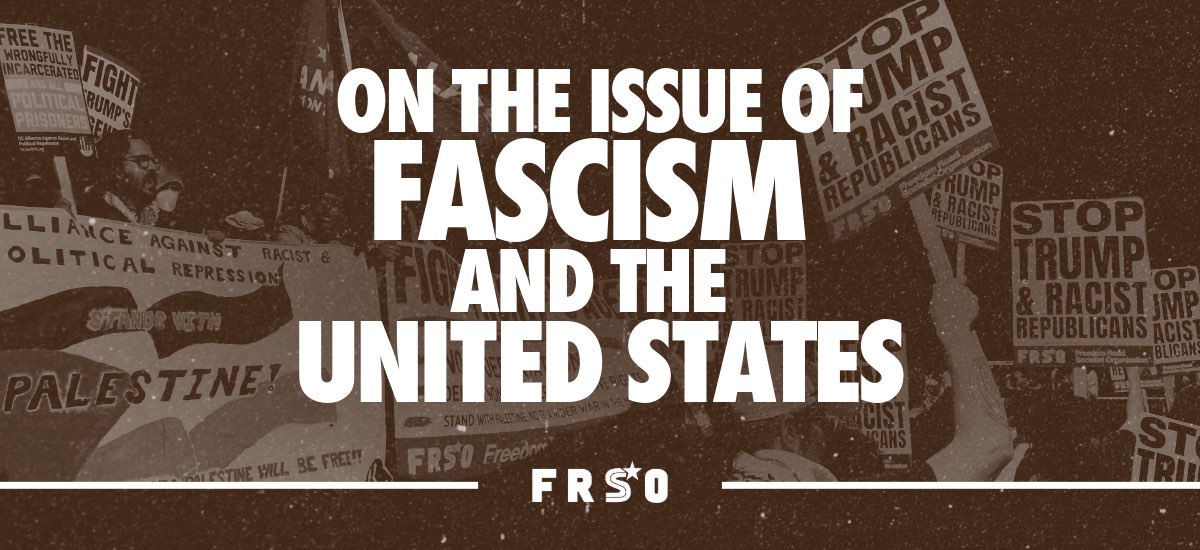
The following paper by Mick Kelly, the Political Secretary of Freedom Road Socialist Organization (FRSO), was presented at the National Democratic Front of the Philippines (NDFP) International Theoretical Conference on Fascism in the 21st Century in the Imperialist Heartlands. Sydney Loving of the Central Committee of FRSO also participated in the conference, which took place November 28-29, in Utrecht, the Netherlands.
Comrades and friends,
Let me start by thanking the National Democratic Front of the Philippines for organizing this most important event. In providing a venue for revolutionaries to address the big theoretical issues facing our respective movements, the NDFP is making a real contribution to our collective efforts to shatter the chains of monopoly capitalism.
The question of fascism is an important one, and it can impact one’s strategy, tactics, and a host of organizational measures; in fact, the fascism question can be one of life and death. There is also a wealth of important texts that address the issue, and of special importance are those of works of R. Palme Dutt and Georgi Dimitrov – both of which received wide circulation by the Communist International.
Comrades might be interested to know that the issue of fascism is a mass question among large numbers of progressive people in the U.S., given the wave of attacks unleashed by the reactionary Trump administration, Over the past 9 months, millions of people, in big cities and small towns, have taken to the streets. The extremely sharp struggles against mass deportations – including the uprising in Los Angeles and high level of struggle in Chicago and Portland, Oregon – make up one of the main issues shaping domestic politics.
We see the overall conditions as extremely favorable for building communist organization. As FRSO has been able to play an important role in these fights, we continue to be in a period of extraordinary growth.
What fascism is
For some, “Fascism” as an invective – a sort of swear word, the worst thing that you can call someone or some action of government – as opposed to a political category with a scientific definition. This is a long-standing tendency on the part of the petty bourgeois left, and certainly there is no one here who does that. Others, like the Trotskyites [1], see fascism as the product of a mass movement of the petty bourgeoisie. That is not correct either.
We are in agreement with the definition adopted by 13th plenum of the Executive Committee of the Communist International which states fascism is, “the open terrorist dictatorship of the most reactionary, most chauvinistic and most imperialist elements of finance capital.”
At the 7th Congress of the Communist International, Dimitrov pointed out, “The accession to power of fascism is not a ordinary succession of one bourgeois government by another, but a substitution of one state form of class domination of the bourgeoisie – bourgeois democracy – for another form, open terrorist dictatorship.” [2]
This is an important point. While it is true there is not a qualitative difference between fascism and bourgeois democracy, in the sense that they are both ways that the monopoly capitalist wield state political power, there is a qualitative difference in so far as one is very different than the other when it comes to democratic rights of working and oppressed people.
Fascism and capitalist democracy are different forms of political rule. The fact that there is real difference between the two means that revolutionaries will employ different tasks, objectives, and organizational measures depending on the form of bourgeois rule. Communist organizing in a period of open terror is for all practical purposes illegal.
Fascist governments wage aggressive wars characterized by extremes of national chauvinism. In fact, bourgeois democratic governments have always done the same and often resort to the use of open terror to maintain control of their colonies or neo-colonies. In fact, the use of open terror in the neo-colonial or colonial settings is a feature that is common to fascist and bourgeois democratic governments.
In his important work The State and Revolution, Lenin points out, “A democratic republic is the best possible political shell for capitalism, and, therefore, once capital has gained possession of this very best shell (through the Palchinskys, Chernovs, Tseretelis and Co.), it establishes its power so securely, so firmly, that no change of persons, institutions or parties in the bourgeois-democratic republic can shake it.”
Why would the ruling class give up this “best possible political shell”? Stalin responds that it is because they have to:
In this connection the victory of fascism in Germany must be regarded not only as a symptom of the weakness of the working class and a result of the by the betrayals of the working class by Social-Democracy, which paved the way for fascism; it must also be regarded as a sign of weakness of the bourgeois, a sign that the bourgeois is no longer able to rule by the old methods of parliamentary and bourgeois democracy, and, as a consequence, is compelled in its home policy to resort to terrorist methods of rule — as a sign it is no longer to find a way out of the present situation on the basis of a peaceful foreign policy, and, as a consequence, is compelled to resort to a policy of war. [3]
Finally let me quote from R. Palme Dutt, “Fascism is not inevitable. Fascism is not a necessary stage of capitalist development through which all countries must pass. The social revolution can forestall Fascism, as it has done in Russia. But if the social revolution is delayed, then the menace of fascism becomes urgent.” [4]
So, there are several themes that should be circled back to. First, fascism employs open terrorism. Sure, there can be courts and parliaments, but open terrorism is what the fascist state is organized around and for. Secondly, fascism is a tool of the financial oligarchy – particularly its most reactionary and chauvinist sectors. And finally, there is the issue of extreme national chauvinism and fascism’s war-like nature.
To what degree is there a fascist danger in the U.S.?
In the entire epoch of monopoly capitalism, fascism is a latent tendency and therefore a possibility, given that the necessary conditions are present. In a context where the decline of U.S. imperialism is accelerating, where polarization is sharpening in the political superstructure, it is necessary to have a materialist evaluation of the objective conditions. That includes a realistic assessment of an immediate fascist danger.
When identifying what fascism is, in our view the most essential feature is the use of open terror by the ruling class, meaning the legal possibilities to organize for socialism are slim to nonexistent. That is not currently the situation in the United States, and communists in the U.S. need to utilize every avenue and opportunity to build the people’s struggle while developing revolutionary organization.
It is a fact that there are fascist groups and there are people in government who are pro-fascist. These elements are present in the military too. Their attacks should be met head on. The events of January 6, 2021, when Trump attempted to block the peaceful transfer of power and his supporters stormed the U.S. Capitol, speaks volumes about the lengths reactionaries will go to – as well as some of the limitations that necessity places on them.
The U.S. has always repressive place. Even as it went to war on German fascism and was an important part of the world anti-fascist coalition, 120,000 Japanese Americans were put in concentration camps.
Whatever assessment one has about a fascist danger, repression and resistance to repression need to be taken seriously. This means opposing reactionary laws and measures that restrict our democratic rights. It also means pushing back hard against legal attacks we face. Over the past 15 years our organization has faced a fair amount of repression, [5] and we have developed some capacity to deal with it. The most recent example was the defense of an immigrant rights activist and comrade who was charged with conspiracy to further civil disorder in the aftermath of the anti-ICE rebellion in Los Angles. We build a broad, national defense campaign and charges were dropped.
All quantity includes quality – and there is a whole political landscape between capitalist democracy and open terror (fascism) that could be very different from what we have experienced over the past 50 years.
Fascism is a tool of the most reactional monopoly capitalists to prevent revolution. In the U.S. today, we are not in a revolutionary situation. An effective strategy against fascism would necessitate building the broadest possible united front to stop it, like for example the Popular Front employed by U.S. communists from the mid-1930s on. If there is an immediate danger of capitalist democracy being replaced by open terror, we can and will adjust our strategy and organizational functioning accordingly.
Comrades: communists have a rich history of resisting repression and defeating fascism. It was Soviet soldiers who planted the flag bearing a hammer and sickle on the ruins of the “thousand-year Reich.” Our comrades of the Philippines have repeatedly demonstrated it is possible to grow and thrive in the context of U.S.-sponsored terror. The road might be a hard one, but our future is bright.
Let me close with a quote from the outstanding revolutionary and Marxist-Leninist Mao Zedong:
I have said that all the reputedly powerful reactionaries are merely paper tigers. The reason is that they are divorced from the people. Look! Was not Hitler a paper tiger? Was Hitler not overthrown? I also said that the tsar of Russia, the emperor of China and Japanese imperialism were all paper tigers. As we know, they were all overthrown. U.S. imperialism has not yet been overthrown, and it has the atom bomb. I believe it also will be overthrown. It, too, is a paper tiger.
Long live proletarian internationalism! Long live the unity of the world’s peoples! Victory is certain, together we will win!
Notes
[1] Trosky states in Fascism: What it is and how to fight it, “The fascist movement in Italy was a spontaneous movement of large masses, with new leaders from the rank and file. It is a plebian movement in origin, directed and financed by big capitalist powers. It issued forth from the petty bourgeoisie, the slum proletariat, and even to a certain extent from the proletarian masses; Mussolini, a former socialist, is a “self-made” man arising from this movement.”
[2] Dimitrov, The Fascist offensive and the tasks of the Communist International in the fight for uniy of the working class against fascism, 7th Congress of the Communist International, page 127
[3] J. Stalin, Report to the 17th Party Congress, CW vol. 13, page 300
[4] R. Palme Dutt, Fascism and Social Revolution
[5] In 2010 more than 70 FBI agents carried out coordinate raids against antiwar and international solidarity activist – including the homes of a number of FRSO members.
#RevolutionaryTheory #FRSO #Statement #Fascism #NDFP #Philippines #Lenin #Stalin #Mao #MarxismLeninism