
Holy Land 5 panel in Grand Rapids, MI: ‘Free Shukri Abu Baker and Ghassan Elashi’
Grand Rapids, MI – Nida Abu Baker was a child when the FBI began their decades long campaign of repression against her father, Shukri Abu Baker, and the charity he helped run, The Holy Land Foundation for Relief and Development (HLF).
After trumped-up material support for terrorism charges and nearly two decades of prison, Shukri and his colleague Ghassan Elashi still remain behind bars. Their crime: fundraising for humanitarian aid and the construction of schools and clinics within Palestine.
It was weeks after 9/11, and the U.S. was already flexing its domestic muscle by ramping up its Islamophobic “war on terror.” Shukri Abu Baker, alongside his colleagues Mohammad El-Mezain, Ghassan Elashi, Mufid Abdulqader and Abdulrahman Odeh, were some of its earliest domestic victims.
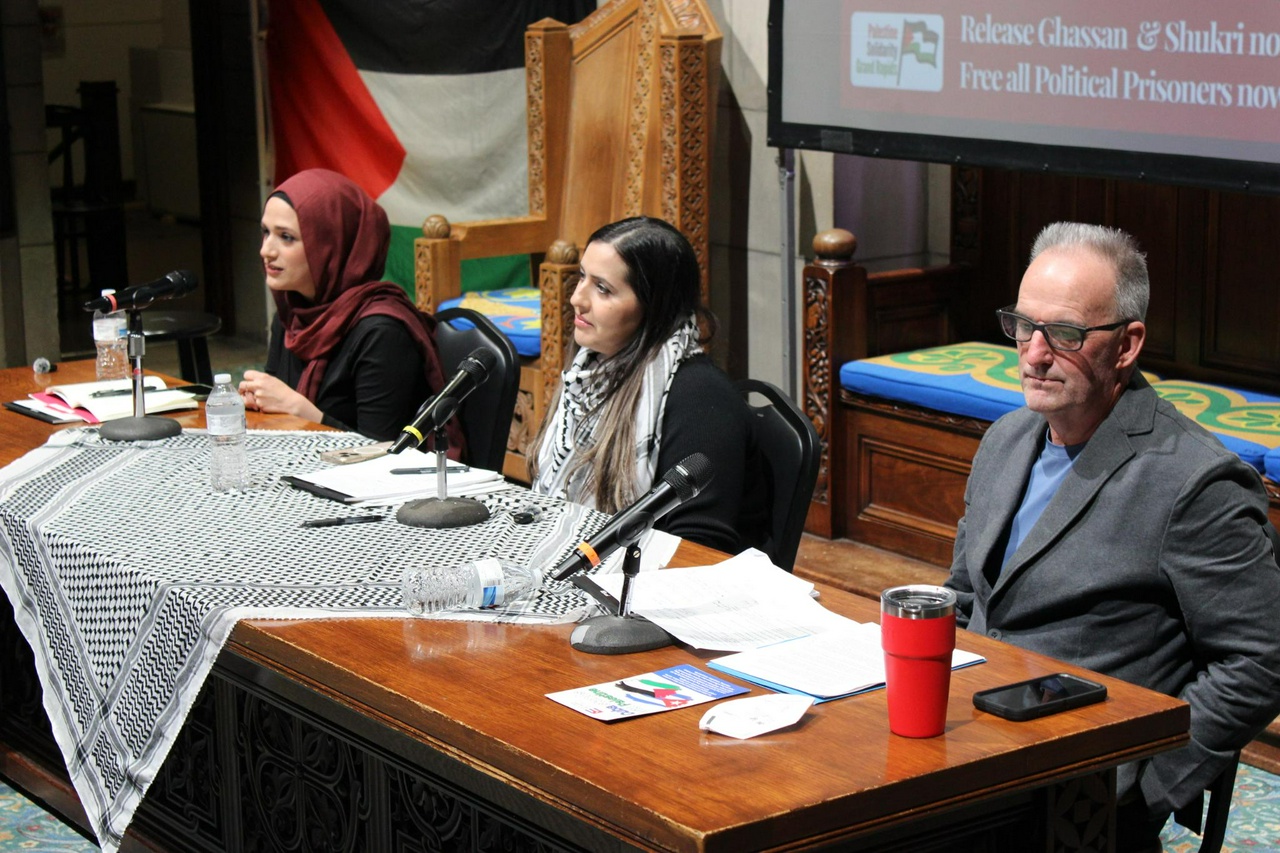
Palestine solidarity activists in Grand Rapids were honored to have Nida Abu Baker speak on her own activism and the struggle to free her father and his colleagues from prison. She was joined by Zena Ozier, an activist-lawyer with the US Palestinian Community Network (USPCN), and Tom Burke, a member of the Anti-war 23 and labor leader, for a panel discussion featuring the story of the Holy Land 5 and the struggle of political prisoners at home and in Palestine.
“Politically, I didn’t choose activism. Activism chose me. I had no choice. My politicization came from my personal experience,” Nida Abu Baker began. “Everything that I am now is because of my childhood. When the HLF shutdown it’s like I lost my home. A lot of people in the community felt the same way. Homes were raided. Phones were tapped, people we loved were suddenly gone and deported. I was only seven years old when the initial raids happened, but I understood why we were being targeted – that helping Palestinians was being criminalized.”
After their sentencing, it became clear that the U.S. had been surveilling the Holy Land Foundation since the mid-90s. In 2001, the Foundation was raided and its assets were frozen. In 2004, the U.S. indicted the Holy Land 5 and raided their homes. In 2008, the five were convicted and sent to jail with heavy sentences ranging from 15 to 65 years.
“Growing up I remember seeing an unmarked FBI vehicle always parked in our neighborhood. The phones always sounded fuzzy – we knew we were tapped and we knew we were being watched. But that didn’t stop us from living normally,” said Abu Baker
When asked about her background and her own activism, Zena Ozier explained: “I learned to question the law. As a Lebanese American, I understood occupation. My maternal village had been occupied by Israel. My own lineage and family carried the struggle – it's part of my ancestry. The law here isn’t meant to protect people like us.”
Ozier continued, “Since the repression of the Holy Land 5, the U.S. uses several mechanisms to repress activists. For example, the prosecution itself was meant to send a chilling message to other organizations that even humanitarian aid could lead to prison time.”
The panelists also made it clear that solidarity between activists, groups, and between those facing political repression was necessary for combating these types of bogus charges.
“There were ties between what happened to the Anti-war 23 and the Holy Land 5,” explained Tom Burke. “Their goal was to give us sentences like what the Holyland 5 received – 15 years for just one charge.”
Both Shukri Abu Baker and Ghassan Elashi are in Beaumont Prison complex in Texas. Both face worsening conditions brought on through almost 20 years of imprisonment and mistreatment.
“My father has had two near-death experiences while in Beaumont,” Nida Abu Baker said. “The conditions there are horrible. Once, my father was gassed by guards while other prisoners were fighting and he collapsed. If it weren’t for other inmates coming to his aid he would’ve passed away. Guards are constantly harassing him, raiding his room, and cutting him off from the outside world. Despite this he is an activist within the prison and has helped transform the lives of his fellow inmates for the better.”
The panelists fielded many questions from the audience on international solidarity, the Palestinian prisoner movement, and on organizing strategies.
Watch the full livestream of the event on Instagram @palestinesolidarity_gr
#GrandRapidsMI #MI #InJusticeSystem #PoliticalRepression #HolyLand5 #AntiWarMovement #Palestine